
By Eman Abdallah Kamel
Eman is a writer and textile engineer. She received a Bachelor’s in Textile Science from the Faculty of Applied Arts, Egypt.

Dyes Defination
Oxford Learner’s Dictionary defines “dye” as a substance or liquid used to change a material’s colour.
In textiles, dyes are divided into natural and synthetic. Natural resources can be extracted from plants, animals, or minerals. Synthetic is man-made and produced chemically.
In 2021, Germany, China, and the United States were the major exporters of paints and dyes worldwide.
Why are dyes absorbed into the pores of the material?
Because the size of the dye molecules is smaller than the size of the pores in the fiber, the shape of the dye molecules is like narrow strips of paper, with length and width but relatively small thickness. This flat shape helps them slide into the polymer system when the fiber is introduced into the dye bath. Another reason is the affinity of the dye to the fiber due to attractive forces.

Classification
Dyes are divided into the following:
- Natural
- Synthetic
1. Natural
Natural dyes have better biodegradability than synthetic dyes. They are non-toxic, non-allergenic, and non-carcinogenic, derived from plants or animals without the use of chemical treatments. Natural dyes are more expensive because they cannot be mass-produced, but they produce a wide range of bright and soft colors.
Dyes can be obtained from natural sources such as plants, insects, or minerals. For example,
- Indigo, known for its bright blue color, is obtained from the plant’s leaves, soaked in water, and fermented to convert the glycoside indican naturally present in the plant into the blue dye indigotin.
- Red dye lac is extracted from the Kerria lacca insect, native to India, Southeast Asia, Nepal, Burma, Bhutan, and southern China. The female lac insect secretes a resin used to make red dye.
- Mineral dyes, such as iron oxide powder, impart a brown hue. Buff is made from ferrous sulfate.

How are natural dyes extracted?
Natural dyes are extracted using various techniques after drying and grinding the plant materials, and the appropriate solvent is selected according to the dye and then extracted using traditional and modern techniques. The isolated targeted compounds used in dyeing are separated using chromatographic or other separation techniques, and the separated compounds are characterized using spectroscopy.
2. Synthetic
Many types of synthetic dyes are available, including:
- Direct Dyes
- Reactive Dyes
- Vat Dyes
- Acid dyes
- Disperse Dyes
- Azoic Dyes
- Sulphur Dyes
- Basic dyes

1. Direct Dyes
Direct dyes are applied to the cloth in an alkaline or neutral bath. They are suitable for dyeing jute, cotton, linen, rayon, silk, and wool. They produce bright colors but poor washfastness. Direct dyes are anionic dyes and are usually applied from an aqueous dye bath containing an electrolyte (sodium chloride (NaCl) or sodium sulfate (Na₂SO₄)).
Did You Know?
CI direct blue 67 and CI direct red 81 were studied to optimize the conditions in the exhaust dyeing process by varying the salt concentration, time, temperature, and liquid ratio. Table salt (NaCl) or Glauber salt (Na2SO4·10H2O) was used as the depleting agent. The color yield, washing fastness, rubbing fastness, and light fastness were measured. 50 g/L of Na2SO4·10H2O to dye 4 g of cotton fabric in a liquid ratio of 1:10 for one hour at 95 °C gave the best results. After treatment, a fixer (Tino-fixer) was required.

2. Reactive Dyes
Reactive dyes are successful synthetics due to their wide range of shades, application flexibility, and excellent fastness properties. They are used for dyeing wool, silk, cotton, bamboo, rayon, and Kevlar.
Did You Know?
Wool reactive dyes have captured a sizable portion of the market. Ciba (now Huntsman) has developed excellent dark blue and black formulations that match the color and fastness properties of chrome dyes on wool that have not been treated. Reactive dye use is expected to rise in response to existing and future environmental limitations on heavy metal discharges, which could impact the use of pre-metallic and chrome dyes.

3. Vat Dyes
Vat dyeing is a process that takes place in a vat or a bucket. The first synthetic vat dye was indigo, produced in 1879. They belong to anthraquinone groups and have comprehensive fastness properties when dyeing cellulosic fibers. Vat dyes are marketed in water-insoluble form. They are converted to their soluble form (LEUCO) by reduction with caustic soda and sodium sulfite when applied to cellulosic fabrics during dyeing. The soluble form is changed back into the insoluble form during the last dyeing step by oxidation and soaping. After soaping, the right shade of vat dyes with the required fastness properties is developed. Because of the application technique and initial cost, vat dyeing is expensive.
Did You Know?
A study focused on an eco-friendly approach to dyeing cotton fabrics using natural reducing agents and compared their performance with a conventional reducing agent such as sodium dithionite. Natural reducing agents were derived from pineapple bark, watermelon, and carambola extracts. Different colorimetric properties, color strength, and fastness were analyzed. Carambola extract showed the best colorimetric properties among the three reducing agents tested. The study demonstrates the potential of natural reducing agents as eco-friendly alternatives for the vat dyeing of cotton fabrics.

4. Acid dyes
The acid dyes are mostly used for wool and silk, but to a lesser extent, nylon fibers. Acid dyes are anionic and soluble in water. Wool, silk, and nylon are dyed with acid dyes by forming an ionic bond between the acidic group, such as COOH and SO3H of the dye, and the NH2 group of the fiber. While lightfastness is good, washing fastness is not so good. Acid dyes are cheap dyes.
What does acid mean?
An acid is a molecule or ion that can donate a proton (hydrogen ion, H+) or form a covalent bond with a pair of electrons.

5. Disperse Dyes
Disperse dyes are water-insoluble, non-ionic dyes used for dyeing synthetic fibers, cellulose diacetate, and cellulose triacetate. Disperse dyes are polar molecules having azo or anthraquinone groups. Since they are always applied at higher temperatures, some of the dye may sublimate; their classification is based on fastness to sublimation. Fastness properties are good on polyester.
Did You Know?
The azo dyes disperse blue 79:1 (DB) and disperse orange 25:1 (DO) are toxic when introduced into the environment in quantities or concentrations that cause immediate or permanent adverse effects on the environment. In addition, they harm the aquatic system by producing metabolites during their formulation.
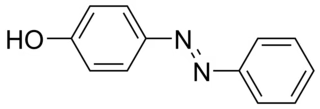
6. Azoic Dyes
Azo dyes have the functional group R−N=N−R′, where R and R′ are typically aryl and substituted aryl groups. Azoic dyes are mostly used on cotton and for special purposes on nylon. Cotton is dyed with azoic dye in two stages: the first consists of treatment with naphthol, and the second involves treatment of the naphthol material with a diazotized base or a diazotized salt. The development of the dye occurs by the coupling reaction between naphthol and the diazo component. It has good washing fastness and has poor to excellent lightfastness.
Azo dyes are the largest synthetic dye class and represent the largest production volume in dye chemistry. The enormous success of azo dyes is due to:
- The coupling reaction’s simplicity,
- Enormous possibilities of structural changes and the ability to adapt to the needs of the most diverse applications of these dyes.
Did You Know?
Azo dyes break down during use and release chemicals known as aromatic amines, some of which are carcinogenic. The European Union has banned these azo dyes, which release carcinogenic amines. To learn more about the list of toxic azo dyes, visit banned amines.

7. Sulphur Dye
Sulfur dyes are used to dye cellulose or synthetic fibers. They are inexpensive and have good wash-fastness. Most sulfur dyes are insoluble in water, and their molecular structure is more complex. They are sulfur or sodium sulfide heated with aromatic amines, amino phenols, and other organic compounds. Sulfur dye needs to be dissolved in sodium sulfide or alkaline hydrosulfite solution to reduce it, then absorbed by the fiber and oxidized to display the color.
Did You Know?
According to a study, when sulphur dyes are reduced in the presence of an alkaline agent, a reducing agent such as sodium hydrosulphite, and a catalyst, where the reducing catalyst is a bacterial extract, it is an energy-efficient, cost-effective, and sustainable dyeing process along with improved dye absorption and fastness properties.

8. Basic Dye
Basic dyes contain groups like the (-NH₂) or (-NR₂). The mechanism of this dye involves attacking the anionic sites present in the fabrics and getting attached to them. Basic dyes are used to dye cotton, wool, modified nylons, and polyester. Also, they give acrylics bright colors and good fastness.
Examples include crystal violet, malachite green, and aniline yellow.
General Tips During Dyeing
While dyeing, try to follow the following tips:
- Wear gloves and long-sleeve clothing.
- Avoid inhaling fumes, and try to wear a face mask at all times.
- The place should be well-ventilated.
- If dyes come into contact with the skin, wash them quickly with water. If skin redness occurs, consult a doctor.
- Store unused dyes in tightly closed containers.
Sources
- Leading exporters of paints, dyes, and varnishes worldwide in 2021
- A brief review on natural dyes and pigments: Recent advances and future perspectives.
- Natural Dye Sources and its Applications in Textiles: A Brief Review
- Dyeing Wool with Reactive Dyes
- Anthranone vat dyes… pdf
- toxicity of Disperse Dyes and its Removal from Wastewater Using Various Adsorbents: A Review
- Azo dyes in clothing textiles can be cleaved into a series of mutagenic aromatic amines which are not regulated yet
©Eman Abdallah Kamel, 2024
Latest Posts
- Comparison Between Oxidizing and Reducing Agents
- Treaty of Hudaybiyyah: Events and Benefits
- Battle of the Trench: Reasons, Events, and Benefits
- Silk Roads: Discover Ancient and Modern Silk Roads
- Dyeing of Acrylic Fibers with Basic Dyes
Leave a Reply