
By Eman Abdallah Kamel
Eman is a writer and engineer. She obtained her bachelor’s degree in textile sciences from the College of Applied Arts in Egypt.
Humans have been producing felt for use since antiquity. The history, types, shapes, qualities, uses, and production processes of felt are all covered in this article. As well as the compactor felt and its features.

Felt
Felt is a structure formed by interlacing fibers through a suitable combination of mechanical, chemical action, moisture, and heat without spinning, weaving, or knitting.
Felt is made from wool with or without a mixture of other animal, plant, or synthetic fibers.
The first discovery of felt dates back to 3500–3000 BC. Felt was made from the hair of various animals pressed together. The fabric was used to make protective clothes and tents for shelter.
In 2021, the largest exporters of Felt were China, Germany, the United States, Italy, and Turkey. The major importers of Felt were the United States, Germany, Mexico, and France.
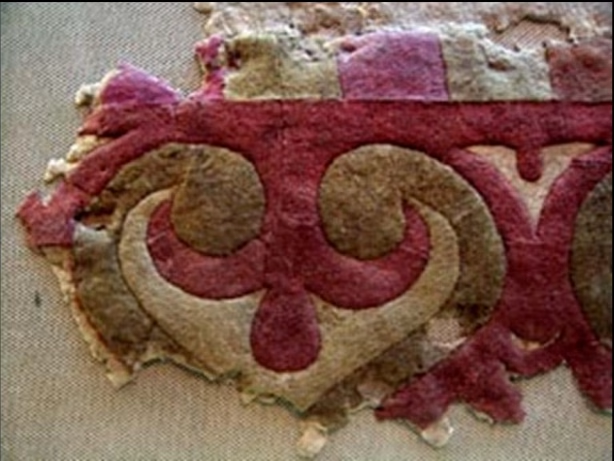
History
Felting by twisting, beating, and pressing animal wool is older than spinning and weaving. Felting was present in ancient times in both Asia and Europe.
In Asia, felt was most commonly used by the nomadic tribes; remnants of felt have been found in Central Asia.
In China, during the Han Dynasty (201 BC–220 AD), felt was well established and used in the form of mats. Emperor Wen (179–152 BC) wore a felt hat on hunting trips. Felt is still made in China to make hats, coats, socks, shoes, tablecloths, and carpets.
In Tibet, felt and leather were common materials for making clothing. It was also used to make dishes. Tibetan kings wore clothes made of felt.
Felt has been known in India since ancient times. The people of India were masters of the art of felting wool. Horses were warmly covered with a felt or woven cloth in two or three layers. Felted blankets (kambala) were made in northern India. Today, felt is manufactured in Ladakh, Hyderabad, and other places. It is used to make blankets, cloaks, and leggings.
Iranians have also made felt since ancient times and exported it to neighboring countries.
Archaeological finds have been made in graves in southern Siberia dating back to the Iron Age. A shoe or sock made of felt belonging to an ancient Turkic tribe was found in these graves. Also, most Turkish tribes in Asia have lived in felt tents throughout the ages. Sewing, embroidery, and felting were hobbies and crafts for women.
The Greeks used felt to make shields, cloaks, and hats.

The Kiddicraft K100 felt pictures appeared around 1937. The fuzzy felt toy was invented during World War II and sold in 1950.
Today, felt has spread all over the world and has many uses.

Felt Wheel/Buffing Wheel. Image source: victoryhardware.com
Forms of felt
The most common felt forms are,
- Felt Sheet
- Felt Rolls
- Felt washers
- Wool-Blended Filter Felt
- Felt wheels/Felt Buffs
- Colored Felt
Felt Types and properties
There are three types of felt:
- Wool Felt
- Blended Wool Felt
- Synthetic Felt
| 100% Wool Felt | Blended Wool Felt | 100% Synthetic Felt |
| It comes from natural fibers, such as sheep or animal fur wool. | Various proportions of polyester, nylon, rayon, polypropylene, or cotton are mixed with wool to control performance and cost. | Felt fabric is made from polyester, Teflon, polypropylene, rayon, Nomex, and Kevlar. |
| Excellent wicking and durability as well. | The felt fabric has high durability. | The fabric withstands high temperatures. |
| It is most often woven or pressed. Needling is another method for making the fabric. | It is woven, needled, or pressed. | Felt fibers are needled or woven to form textiles that meet the fiber specifications. |
| The fabric has high quality and density. | The felt fabric has low cost and density. | High tolerance to bleaching. |
Manufacturing Process
Felt is manufactured in two ways:
- By Hand
- By Machine
1. Hand Process
First, thoroughly blend, mix, and unfold the fibers. The open fibers are spread in a mesh pattern on the cement floor. A warm alkaline and 3% soap solution is then spread over the mesh. Pressure is then applied by hands/rollers to facilitate the milling and migration processes.
The material is rolled into a cylindrical shape by hardening processing, which is done by pushing the wet cylindrical rolled material to and fro with uniform pressure from the hand. Each blend goes through this process for two to three hours until a sheet with consistent thickness and dimensions is produced. It is then rinsed and dried.
2. Machine Process
In this process, the wool fibers undergo two successive carding operations to make the fibers parallel and equal in thickness in the form of a fine mesh. Many layers of mesh are built up until a sufficient amount of weight or thickness has accumulated.
The web layer is then cut, and the edges are cut to the required width. The layer is usually about 37 meters long and 150–230 cm wide, and its weight ranges from 8–23 kg.
The layers are equally sprayed with warm water, passed over a steam box to warm the fabrics, and then pressed between two rollers. The upper roller rests on the layer in an oscillating motion and exerts pressure, which is combined with moisture and heat to produce the final felt process.
The layers are then drained and cooled for approximately 24 hours. The felt is then moistened with a solution of soap and soda and subjected to hitting with hammers for a period of 5 to 30 minutes.
The wool felting behavior depends on some factors:
1. Basic properties: surface structure, frictional behavior, lengthways, or cross-elasticity.
2. Secondary properties: smoothness, length, curl, and grease content.
3. External factors: conditions during felting such as pH, milling auxiliaries, and temperature.
Felt Finishing
Wool felt can be subjected to one or more different finishing methods to enhance the properties of the fabric.
The felt fabric is sheared to produce a smooth, even surface.
It can be moth-resistant, flame-resistant, or waterproof.
The fabric can be dyed to resist fading, sweating, and washing.

Compactor Felt. Compacting felt materials are aramid, wool, and polyester. Image source: feltbelteast.com
What is compactor felt?
Compactor felt is an endless needled felt that consists of polyester, polyamide, and wool. It has a very smooth surface. The fabric withstands very high heat during the compaction process.
The layers of compactor felt are:
- Nomex is on the surface layer because of its outstanding properties, including tear strength, high heat resistance, and non-flammability.
- Wool and polyester are on the bottom layer.
Did You Know?
Nomex and Kevlar both belong to aramid synthetic fibers. In a compactor machine, the temperature does not exceed 280°C. Nomex shows heat resistance up to 280°C, while Kevlar shows up to 480°C and polyester up to 180°C. So, a blend of Nomex and polyester ply is enough for the compactor felt to withstand the heat generated in the compaction process.
Features of compactor felt:
- The aramid surface can supply high-temperature resistance up to 190°C for a long time.
- Standard specifications are a working temperature of 230°C (100% Nomex). A thickness of 18 to 22 mm and an internal circumference of 2000 to 6000 mm. A width of <3200 mm and a weight of 8000 g/m² (20 mm thick).
- 30%, 50%, or 100% of a ratio can be used for Nomex. As the Nomex percentage reduces, the polyester ratio will rise. As a result, temperature resistance will decrease.
Uses of felt
Felt is used to make clothing, hats, shoes, furniture, rugs, home decor, and other arts and crafts.
In addition, felt is used in the automotive upholstery industry.
Felt is used as a sound or vibration attenuator and as an air filter.
Aramid felt finds application in the heat insulation and brake pads of automobiles, as well as in composite materials for aircraft parts.
Aramid felt is also used to make bulletproof vests and firefighter equipment. Furthermore, in factories that use high temperatures, aramid fiber is utilized in filter bags.
sources
- feltmanufacturing.com
- An overview of the production of non-woven fabric from woolen materials.
- Types of felt.
- scribd.com
- shreefelts.com
- Compactor Felt: Overview, Different Brand Analysis, and Comparison.
- https://oec.world/profile/felt.
©Eman Abdallah Kamel, 2024
Latest Posts
- The Story of The Prophet Moses
- Glass Fiber: Manufacturing Process, Types, and Properties
- Denim Fabric Dyes
- Denim: Manufacturing Process, Properties, and Types
- Surah Al Qadr: Explanation and Benefits
Leave a Reply